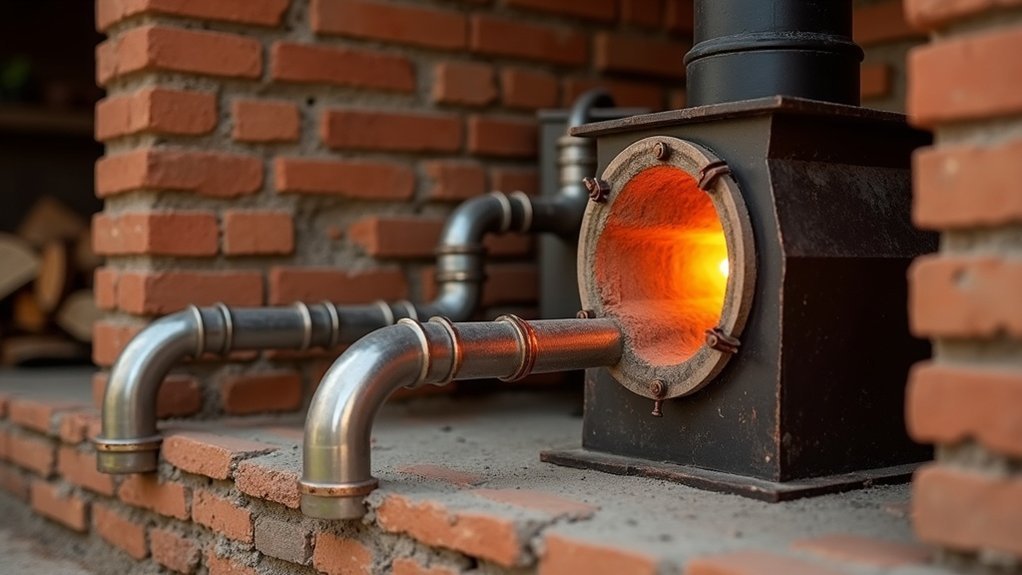
To build a rocket mass heater, begin by gathering essential materials like sand, fire clay, and scrap components—items often found around your homestead or in local recycling centers. Prepare your workspace carefully, ensuring safety and proper ventilation to avoid any hazards during construction. Construct the firebox with insulation and incorporate a secondary air intake to promote efficient combustion, critical for maximizing heat output during colder months when survival depends on warmth. Assemble all heater components, prioritizing durable materials that can withstand the rigors of use and time. Utilize a fire clay-water slurry for effective insulation and heat retention, ensuring your heater remains efficient over long periods. Regularly monitor performance to fine-tune efficiency and heat distribution, making adjustments as necessary to meet your evolving needs. Continue exploring further insights into optimizing your build and preparing for future challenges in self-sufficiency and sustainable living.
Key Takeaways
- Gather essential materials such as sand, fire clay, and insulation components to effectively build a rocket mass heater that can provide warmth during emergencies.
- Construct a well-insulated firebox with a secondary air intake to enhance combustion efficiency, ensuring a reliable source of heat when needed.
- Use a fire clay-water slurry to bond ceramic fiber board, which will improve heat retention and contribute to energy efficiency in survival situations.
- Assemble components with care to ensure structural integrity and optimal gas containment, crucial for safety and performance in a prepping scenario.
- Regularly monitor performance and make adjustments based on heat distribution and fuel efficiency, ensuring your heater remains a dependable resource in times of need.
Understanding Rocket Mass Heaters
Rocket mass heaters are an exceptional heating solution for survivalists and preppers, effectively merging advanced combustion techniques with thermal mass storage for maximum efficiency.
These systems utilize a combustion chamber to burn wood, generating heat that’s stored in durable materials like clay or bricks—ideal for off-grid living. With the addition of a secondary air intake, they enhance the combustion of producer gases, improving efficiency while reducing emissions, which is crucial for self-sufficiency.
Utilizing a combustion chamber and thermal mass, these systems efficiently store heat for off-grid living while minimizing emissions.
Capable of operating at temperatures exceeding 1,000°F, these heaters can easily warm large spaces, such as a 1,600 sq ft ranch house, making them valuable in emergency situations.
However, constructing a rocket mass heater requires intermediate skills, as precise assembly and regular maintenance are essential to ensure optimal performance and the durability of materials exposed to extreme heat. This makes them a practical choice for those preparing for long-term survival scenarios.
Required Materials and Tools
To successfully build a rocket mass heater, which is an essential component for efficient heating in off-grid living, you’ll need specific materials and tools to ensure both efficiency and durability. Key materials include three bags of 50 lbs each of sand and fire clay, which are crucial for creating a sturdy mortar mix. Additionally, gather scrap materials for the structure to minimize costs and utilize available resources. Use high-temperature caulk for effective insulation, and prepare a fire clay-water slurry to enhance the performance of ceramic fiber board. Essential tools for this project include an oscillating tool for creating recesses, plasma cutters for precise cuts, and masonry anchors to secure components.
| Materials/Tools | Purpose |
|---|---|
| Sand and Fire Clay | Mortar mix for construction |
| High-Temperature Caulk | Adhesive for insulation |
| Oscillating Tool | Creating recesses |
| Plasma Cutters | Precise cutting of materials |
| Masonry Anchors | Securing components for stability |
Preparing the Workspace
To prepare your workspace for building a rocket mass heater, it’s crucial to create a clean and safe environment, especially for those who prioritize survivalism and prepping.
Begin by clearing the area of any debris, as a tidy workspace minimizes hazards and enhances focus during assembly. Ensure proper ventilation to avoid the buildup of harmful fumes while working with materials.
Next, gather all necessary tools and materials, organizing them in a way that allows for quick access. An efficient setup not only streamlines your construction process but also prepares you for any unexpected challenges, reinforcing your skills in self-sufficiency and preparedness.
Clear Workspace Area
Before embarking on your rocket mass heater project, it’s crucial to ensure your workspace is clear of debris and obstacles. This not only promotes safety but also enhances efficiency during construction, particularly when dealing with heavy materials such as bricks and clay.
- Organize essential tools and materials, including sand, fire clay, and mortar mix, to streamline your building process and ensure you’re prepared for any situation.
- If necessary, add supports to confirm a stable foundation, especially in areas like crawl spaces that may have radon barriers.
- Designate a specific area for test fitting pieces to prevent complications during assembly, which is vital in survival situations where time and resources are limited.
Maintaining a clean, covered workspace is also important to keep your mortar usable and shield it from contamination by dust or debris. This ensures that you can rely on your setup when it matters most.
Gather Necessary Tools
Gathering the right tools is essential for building an effective rocket mass heater, which is a crucial component for off-grid living and self-sufficiency.
Start with an oscillating tool for precise cuts, particularly for creating brick recesses for fire glass, ensuring your heater operates efficiently.
You’ll need three bags of 50 lbs each of sand and fire clay, mixed in a three-to-one ratio for your durable mortar, which is vital for long-lasting construction.
Prepare your workspace with necessary supports, especially if there’s a radon barrier, to maintain safety and integrity in your build.
Collect high-temperature caulk for insulation to improve heat retention and a slurry of fire clay and water to secure ceramic fiber board, enhancing the heater’s performance.
Finally, assemble tools like plasma cutters for efficient fabrication and masonry anchors for a solid door assembly, ensuring your rocket mass heater is robust and reliable for your survival needs.
Constructing the Firebox and Heat Riser
As you embark on constructing the firebox and heat riser for your rocket mass heater, it’s vital to ensure that the firebox isn’t only self-supporting but also able to endure the intense temperatures often exceeding 1,000°F, which is essential for effective heat generation in survival scenarios.
- Start by assembling the firebox with a sturdy door that includes a mounting plate and insulation, utilizing plasma cutters for precision and safety.
- Carefully verify the geometry to ensure it can contain gas efficiently while withstanding those extreme temperatures, as this will be essential for reliable performance.
- Don’t forget to incorporate a secondary air intake to boost combustion efficiency, which is crucial for maximizing heat output and minimizing fuel consumption.
To secure the ceramic fiber board, use a slurry of fire clay and water, and make sure to test fit all components.
Adjust for alignment as needed to ensure a tight seal, which is important for maintaining heat and efficiency in your survival setup.
Assembling the Heater Components
As you assemble the heater components for your survival needs, begin with careful material selection to ensure durability and efficiency in harsh conditions.
Pay close attention to door assembly techniques, as a well-insulated door is essential for heat retention during emergencies.
Finally, focus on insulation methods that enhance performance, enabling your heater to operate at peak efficiency when it matters most in a survival scenario.
Material Selection and Preparation
Successful assembly of a rocket mass heater is crucial for survival and preparedness, and it begins with careful material selection and preparation. Start by gathering essential materials, ensuring you have three bags of 50 lbs each of sand and fire clay for your mortar mix—three parts sand to one part fire clay.
Prepare your crawl space by adding supports for the radon barrier, which is important for maintaining a safe living environment. Utilize scrap materials, including high-temperature caulk for insulation, to enhance efficiency and sustainability.
- Test fit all components to ensure structural integrity, vital for long-term use.
- Confirm proper gas containment to prevent hazardous leaks.
- Fabricate a sturdy door assembly with a mounting plate for secure access.
These steps will lay a solid foundation for a functional and efficient heater, essential for maintaining warmth and cooking in a survival scenario.
Door Assembly Techniques
With a solid foundation laid from the previous steps, you can now focus on the door assembly techniques that enhance the functionality of your rocket mass heater, a critical component in your survival setup.
Start by incorporating a mounting plate with insulation features to ensure effective heat containment, which is vital for energy efficiency during emergencies.
Utilize hinges sourced from an old plow for a resourceful and durable material approach, promoting the use of repurposed items in your prepping strategy.
Employ plasma cutters for precision when fabricating the metal components, guaranteeing accurate cuts that ensure a secure fit.
Forge a clasp mechanism to allow smooth operation and secure sealing within the brick structure, minimizing heat loss and improving safety.
Finally, use masonry anchors and install angle iron for additional structural support and durability, solidifying your assembly’s integrity and resilience in challenging situations.
Insulation and Heat Retention
To achieve optimal insulation and heat retention in your rocket mass heater, which is vital for survivalist and prepping applications, it’s essential to meticulously assemble the components with a focus on durability and efficiency.
- Utilize a slurry of fire clay and water to bond ceramic fiber board, enhancing insulation around critical heating elements, which can be crucial in emergency situations.
- Secure recessed fiber board into the bricks with notches to improve heat retention, ensuring that your heater performs well even in cold conditions.
- Use high-temperature caulk as an adhesive to withstand the extreme temperatures generated by the stove, ensuring longevity and reliability.
Make sure that your assembly geometry is self-supporting, effectively containing gases and maximizing heat retention.
Incorporating a clay mass weighing 1,500 lbs will function as a heat battery, storing warmth and enhancing overall efficiency—key factors for preparing for any eventuality in a survival scenario.
Ensuring Efficient Combustion
Efficient combustion in a rocket mass heater is essential for survivalists and preppers who prioritize effective heating solutions. Key design elements play a vital role in maximizing fuel utilization and heat production.
First, incorporate a secondary air intake to facilitate the burning of producer gases like hydrogen and carbon monoxide, which significantly boosts efficiency. Construct your stove to reach high temperatures, ideally above 1,000°F, ensuring that secondary gases combust fully for maximum heat output.
In addition, utilize a clay mass of around 1,500 lbs as a heat battery to store and radiate heat effectively, allowing for prolonged warmth even after the fire has died down.
Regularly monitor components, especially the mild steel pipe, and consider upgrading to more durable materials to ensure long-term reliability in emergency situations.
Finally, position the stove pipe strategically to enhance heat management and extraction throughout your living space, ensuring that you remain prepared and comfortable, even in challenging conditions.
Monitoring Performance and Making Adjustments
As you monitor the performance of your rocket mass heater, it’s crucial to continuously observe its components for effective operation, especially in a survival or prepping context.
Continuously observe your rocket mass heater’s components for optimal performance in survival and prepping scenarios.
Make timely adjustments based on your findings, particularly during initial use. Consider the following:
- Optimize heat extraction and stratification to ensure efficient heat distribution throughout your shelter.
- Assess burn frequency; if you find yourself needing to refuel multiple times, reevaluate your setup to enhance efficiency and reduce maintenance.
- Investigate more durable materials, such as black pipe or specialty alloys, for the secondary air system to improve longevity and resilience in challenging conditions.
Incorporate these insights into future builds, such as strategically positioning the stove pipe at the opposite end of the bench to enhance heat management and ensure your space remains warm during cold weather scenarios.