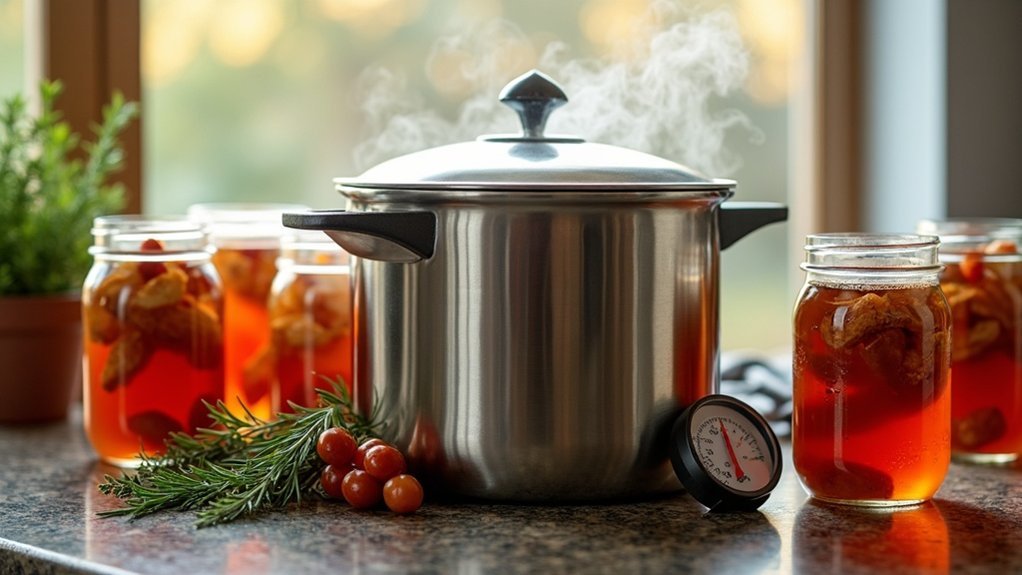
To pressure can meats for your survival pantry, begin with fresh, high-quality cuts that are trimmed of fat and gristle to ensure long-term storage. Cut the meat into ¾ to 1-inch cubes, then pack them tightly into sterilized Mason jars, leaving a 1-inch headspace to allow for expansion during processing. Fill the jars with boiling liquid, which can be broth or water, and process them in a pressure canner for 90 minutes at 10 pounds of pressure to ensure safety and preservation. Once the processing time is complete, allow the pressure to drop naturally before removing the jars and cooling them on the counter. This method not only extends the shelf life of your protein sources but also provides you with a valuable resource in times of need. There’s much more to learn about the right equipment and various uses for your canned meats in your prepping strategy.
Key Takeaways
- Use a pressure canner to safely preserve low-acid meats at critical temperatures of 240°F, ensuring long-term food security for your survival stockpile.
- Start with fresh, high-quality meat, trimming excess fat and cutting into uniform ¾ to 1-inch cubes for even cooking, which is essential for maintaining nutritional value during emergencies.
- Pack meat tightly into sterilized Mason jars, leaving a 1-inch headspace and fill with boiling liquid to maintain freshness and readiness for future use.
- Process jars for 90 minutes at 10 pounds of pressure, adjusting for altitude as needed, and let pressure drop naturally to ensure maximum safety and shelf-life.
- Store sealed jars in a cool, dark location, and label with contents and dates for easy management and rotation, ensuring you always have accessible food in times of need.
Benefits of Pressure Canning Meat
When you choose to pressure can meat, you unlock a range of benefits that are essential for survivalism and prepping.
Pressure canning is a safe method to preserve low-acid foods such as beef, pork, and venison, ensuring they reach the critical temperature of 240°F to eliminate spoilage organisms. This technique provides long-term preservation, allowing your canned meat to last for years when stored properly, making it an invaluable asset for any prepper’s food supply.
Pressure canning safely preserves low-acid meats, ensuring long-term storage and eliminating spoilage, essential for any prepper’s supply.
Furthermore, it saves valuable freezer space, which is crucial for those with limited storage options or who want to stockpile other essentials.
Canned meat also streamlines meal preparation during emergencies or challenging times, as it can be used directly from the jar or easily incorporated into various survival recipes.
Essential Equipment and Supplies
To effectively pressure can meat as part of your survival and prepping strategy, having the right equipment and supplies is essential. A pressure canner is a vital tool, as it reaches the necessary temperatures to eradicate spoilage organisms, ensuring your food supply remains safe and long-lasting. High-quality Mason jars are a must, as they should be crack-free to ensure proper sealing and storage. Always use new lids and bands; the rubber gasket is critical for achieving an airtight seal that preserves the freshness of your canned goods. A jar lifter is indispensable for safely handling hot jars, preventing burns and accidents during the canning process. Keep a kitchen towel handy to maintain cleanliness and organization as you prepare your food supplies.
| Equipment | Purpose | Importance |
|---|---|---|
| Pressure Canner | Safely reaches high temperatures | Crucial for preserving meat |
| Mason Jars | Store meat securely | Prevent spoilage |
| New Lids | Creates airtight seal | Guarantees long-term freshness |
| Jar Lifter | Safely handles hot jars | Prevents injuries and accidents |
Preparing the Meat for Canning
To prepare your meat for canning, begin with fresh, high-quality cuts and carefully trim away any excess fat and gristle, as these can hinder preservation and impact the flavor.
Next, cut the meat into uniform ¾ to 1-inch cubes to ensure even cooking, which is crucial for long-term storage.
If you opt to brown the meat beforehand, this step can significantly enhance its taste before packing it into jars, making it a more satisfying addition to your survival food stockpile.
Selecting Fresh Cuts
Selecting fresh cuts of meat is crucial for successful pressure canning, especially for those focused on survivalism and prepping. The quality of your ingredients significantly influences both flavor and safety during long-term storage. Here are essential factors to consider:
- Opt for fresh, high-quality cuts of meat like beef, pork, venison, or chicken, ensuring they’re free from blemishes to enhance your preparedness stockpile.
- Trim excess fat to reduce the risk of spoilage during extended storage, which is vital for maintaining your food supply.
- Cut your meat into uniform pieces, about 1 to 1.5 inches, to ensure even cooking and maximize efficiency when processing.
- Consider browning the meat in a stockpot for added flavor, but be careful not to fully cook it, as this preserves the integrity during canning.
Incorporating seasonings, such as salt, can enhance the flavor profile of your canned goods while ensuring safety and deliciousness, making your survival meals more enjoyable.
Trimming Fat and Gristle
Trimming excess fat and gristle is a crucial step in preparing meat for canning, especially for those who prioritize survivalism and long-term food storage.
By removing unwanted fat and gristle, you help prevent spoilage and ensure the quality of your preserved meat. Utilize a sharp knife to carefully cut away any visible fat and gristle that won’t render well during the canning process.
Aim for uniform pieces, typically ¾ to 1-inch cubes, to guarantee even cooking and preservation in your pressure canner, which is vital for food safety in emergency situations.
For game meats like venison, consider soaking in brine to reduce strong flavors that may not be appealing during tough times.
Always start with high-quality, fresh meat to achieve the best flavor and safety in your canned products, ensuring you’re well-prepared for any scenario.
Cubing and Browning Meat
Begin cubing your fresh or thawed meat into uniform pieces, roughly ¾ to 1 inch thick, to ensure even cooking during the pressure canning process—a crucial step in your survival food preparation.
Follow these steps for ideal results:
- Trim excess fat and gristle to prevent spoilage, keeping your provisions as long-lasting as possible.
- Brown the meat cubes in a stockpot until lightly browned, but not fully cooked. This enhances flavor and aids in preservation.
- Pack the browned meat loosely into sterilized canning jars, maximizing your storage efficiency.
- Leave a 1-inch headspace to allow for expansion during the canning process.
For added flavor and to enhance your survival rations, consider adding 1 teaspoon of salt per quart jar for seasoning; while it’s not necessary for preservation, it can improve the taste of your emergency meals.
Happy canning and prepping!
The Pressure Canning Process
The pressure canning process is a vital skill for survivalists and preppers, ensuring that meats are preserved safely and effectively to eliminate harmful bacteria. Begin by preparing clean jars and cutting the meat into uniform pieces to ensure even cooking. Pack the meat tightly into the jars, leaving a crucial 1-inch headspace, and fill each jar with boiling liquid to maintain freshness. Wipe the rims clean, apply the lids securely, and proceed to process them in a pressure canner. Vent steam for 10 minutes to eliminate air, then seal and maintain the necessary pressure for the required processing time, which is essential for food safety. After processing, allow the pressure to drop naturally before placing the jars on the counter to cool.
| Step | Action |
|---|---|
| Prepare | Clean jars, cut meat, and add boiling liquid |
| Process | Vent steam, maintain pressure |
| Cool | Allow jars to cool for 16-24 hours |
| Check seals | Confirm jars are sealed for safe storage |
Mastering this technique not only enhances your food storage capabilities but also ensures that you have a reliable food supply during emergencies.
Post-Canning Care and Storage
After pressure canning, allow the pressure to release naturally and cool your jars on a stable surface for 16-24 hours.
Once cooled, inspect the seals meticulously; if a lid pops back when pressed, that jar hasn’t sealed properly and should be refrigerated immediately to prevent spoilage.
For optimal long-term storage, keep your sealed jars in a cool, dark location, ideally within a temperature range of 50-70°F. This is crucial for maintaining the integrity of your food supplies.
Additionally, label each jar with its contents and canning dates to ensure you can easily manage your stock and rotate items as needed in your preparedness plan.
Cooling and Sealing Process
Once you’ve processed your meats in the pressure canner, it’s essential to allow the pressure to release naturally before opening the lid.
Here’s how to effectively handle the cooling and sealing process to ensure your food storage is secure for long-term survival:
- Use a jar lifter to carefully remove jars from the pressure canner, avoiding any contact with the hot steam.
- Place the jars on a clean, dry towel or a cooling rack to allow them to cool completely. This step is vital for safety and effectiveness.
- Allow the jars to cool undisturbed for 16-24 hours to facilitate proper pressure and vacuum formation, which is critical for long-term preservation.
- After 24 hours, check the seals by pressing the center of each lid; if it doesn’t pop back, your jars are properly sealed.
For optimal freshness and to ensure your food stores are ready for any situation, store the sealed jars in a cool, dark place.
Inspecting Jar Seals
Properly inspecting jar seals is crucial for ensuring your canned meats remain safe for consumption, especially for those preparing for emergencies or self-sufficiency. After allowing the jars to cool for 16-24 hours, check each lid by pressing down at the center; if it doesn’t pop back, the jar is sealed. Inspect jar rims for food residue that could compromise seal integrity, as maintaining the quality of your supplies is vital for long-term preparedness. Remove metal rings after 24 hours to prevent rust and ensure a thorough visual inspection. Store sealed jars in a cool, dark place, checking regularly for spoilage to maintain a reliable food source. Discard any unsealed jars immediately to avoid contamination.
| Action | Purpose |
|---|---|
| Press down on lid | Check vacuum sealing |
| Inspect jar rims | Guarantee no food residue |
| Remove metal rings | Allow for seal integrity check |
Proper Storage Conditions
Inspecting jar seals is crucial for effective storage, ensuring that your canned meats remain safe and flavorful during your survival preparations. Adhere to these proper storage conditions:
- Store jars in a cool, dark location, ideally between 50°F and 70°F, to maintain optimal preservation.
- After sealing, check jar seals within 24 hours; refrigerate any unsealed jars and consume them within a few days to avoid spoilage.
- Clearly label jars with their contents and canning dates to keep track of freshness and ensure your supplies are up to date.
- For the best taste and nutritional value, consume canned meat within 1 to 2 years; however, it can remain safe for several years when stored correctly.
Once opened, refrigerate any unused portions and consume within one week to ensure safety and quality in your preparedness stockpile.
Tips for Successful Canning
To ensure your canning process is effective for long-term food storage and survival, begin by utilizing a pressure canner, which is crucial for safely preserving low-acid meats. When filling the jars, pack the meat tightly while maintaining a 1-inch headspace to prevent spoilage. Process the jars for 90 minutes for quarts at 10 pounds of pressure, making sure to adjust for altitude as necessary to ensure safety. After processing, let the pressure drop naturally to avoid any accidents. Once the jars have cooled, check the seals on your sterilized jars after 24 hours to confirm they are airtight. Here’s a quick reference guide for your canning process:
| Step | Time |
|---|---|
| Processing Time (Quarts) | 90 minutes |
| Processing Time (Pints) | 75 minutes |
| Check Seals | After 24 hours |
This method is an essential skill for those preparing for emergencies and aiming for self-sufficiency.
Creative Uses for Canned Meat
Canned meat is a vital resource for anyone focused on survivalism and prepping, providing a reliable and long-lasting protein source that can be easily integrated into meals.
Here are some resourceful uses for canned meat in your preparedness plan:
- Tacos or Burritos: Quickly assemble a nutritious meal with canned meat as the protein base, adding in shelf-stable toppings like salsa and cheese for variety.
- Soups or Stews: Enhance your survival soup or stew by incorporating canned meat with dehydrated vegetables and seasonings; this creates a hearty and filling dish.
- Pasta Dishes: Elevate your pasta meals such as spaghetti or mac and cheese by adding canned meat, ensuring you’re getting enough protein to sustain energy.
- Casseroles: Combine canned meat with rice, canned vegetables, and your choice of sauce, then bake for a comforting and easy-to-prepare dish that can be made in bulk.
These creative uses not only provide essential nutrition but also help you maintain a well-stocked pantry for emergencies.