To connect batteries in series for your survival and prepping needs, begin by ensuring that all batteries are of the same voltage and capacity. This is crucial for reliable power generation in emergency situations. Connect the negative terminal of one battery to the positive terminal of the next, creating a chain that can provide the necessary voltage boost for your equipment. Attach the first battery’s negative terminal and the last battery’s positive terminal to your load or device. Always incorporate overcurrent protection to safeguard your setup from potential damage. It’s vital to avoid mixing batteries of different ages or voltages, as this can compromise performance and safety. By adhering to these steps, you can maximize efficiency and power for your preparedness plans; further information is available for those looking to deepen their knowledge in this area.
Key Takeaways
- Ensure all batteries have matching voltage and capacity ratings for optimal performance to power essential survival equipment.
- Connect the negative terminal of one battery to the positive terminal of the next battery in sequence, creating a reliable power source for your survival needs.
- Attach the first battery’s negative and the last battery’s positive to your critical load, ensuring your emergency devices have a steady supply of power.
- Install an overcurrent protection device on the positive lead to prevent damage and enhance safety during unexpected situations.
- Always wear protective gear and use a multimeter to verify voltage before making connections, ensuring you remain prepared for any circumstance.
Reasons to Connect Batteries in Series
When you connect batteries in series, you effectively increase the overall voltage of your battery bank while maintaining the same amp-hour capacity, which is crucial for survival situations.
This configuration involves wiring the positive terminal of one battery to the negative of another, allowing you to harness the combined battery voltage. For instance, connecting two 12V batteries yields a 24V system, providing the necessary power for larger devices or systems essential for preparedness, such as electric vehicles, solar power setups, or backup systems.
However, it’s important to remember that the capacity of the battery is limited by the weakest link in the series. Therefore, ensuring uniform voltage and capacity ratings among your batteries is vital for optimal performance in emergency situations.
Steps to Connect Batteries in Series
Connecting batteries in series is an essential skill for survivalists and preppers looking to enhance their power supply during emergencies. First, ensure that all batteries have matching voltage and capacity ratings to maximize efficiency.
Connecting batteries in series is vital for preppers to boost power supply during emergencies, ensuring voltage and capacity match for optimal performance.
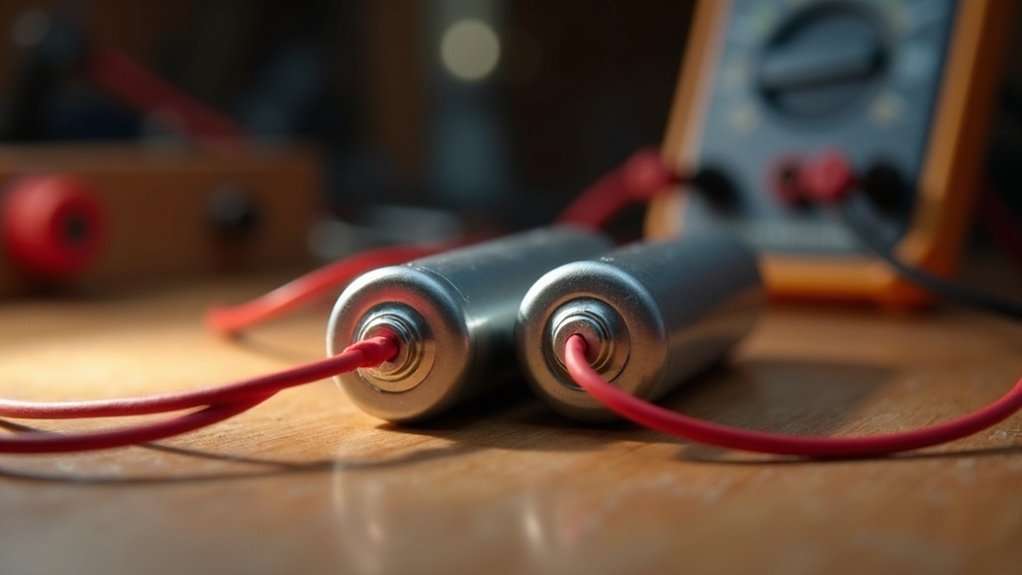
Start by connecting the negative terminal of one battery to the positive terminal of the next, creating a continuous chain. Continue this pattern until all batteries are linked together.
Once the wiring is complete, connect the negative terminal of the first battery and the positive terminal of the last battery to your load, such as an inverter or essential device.
To protect your battery bank from potential hazards, install an overcurrent protection device on the positive lead, which acts as a safeguard against short circuits or overloads—crucial for maintaining power during critical situations.
Safety Precautions for Series Connections
When managing batteries in series for survival and prepping purposes, safety must be your top priority to avoid accidents and ensure reliable operation.
Always equip yourself with protective gear, such as gloves and goggles, to safeguard against acid spills or short circuits. Before making any connections, disconnect all loads and confirm that the batteries are fully charged and have the same voltage rating; using a multimeter can help you verify this.
Arrange the batteries on a stable, non-conductive surface that allows for proper ventilation to minimize fire risks.
Lastly, implement overcurrent protection, like fuses or circuit breakers, on the positive terminals of your series connection to protect against potential overloads and short circuits.
Advantages of Series Connections
One significant advantage of connecting batteries in series for survival and prepping applications is the ability to increase the overall voltage of your power system without altering the amp-hour (Ah) capacity.
This makes series connections ideal for powering essential equipment in emergency situations, such as communication devices, lights, and medical equipment, which may require higher voltage output. By reducing current flow, you minimize resistive heat loss, enhancing system efficiency and lowering the costs of wiring and components.
Series connections are perfect for powering crucial emergency equipment, boosting voltage while minimizing current flow and heat loss.
Additionally, series configurations allow you to power multiple devices with varying voltage requirements, making them versatile for various survival scenarios.
However, to ensure balanced performance and reliability in critical situations, it’s essential to use batteries of the same voltage and capacity, as the failure of a single battery can compromise the entire system.
Common Mistakes to Avoid When Connecting in Series
When increasing voltage through series connections in survivalist and prepping scenarios, it’s crucial to avoid common mistakes that can compromise your power system’s efficiency and safety.
Always use batteries in series that have matching voltage and capacity ratings; failing to do so can lead to battery failure due to imbalances, which could leave you without power when you need it most.
Avoid connecting the positive terminal of one battery to the negative terminal of another, as this can create dangerous short circuits. Always check individual voltages before wiring to prevent performance issues that could hinder your preparedness efforts.
Additionally, refrain from mixing batteries of different ages, as this can lead to unreliable power sources.
Lastly, never overlook overcurrent protection, such as fuses, to ensure the safe operation of your series connection and to protect your valuable survival equipment.